
RoFLEX is one of CEFLEX’s leading pilots in an implementation program already active in 15 Member States – catalysing action and analysing the technical, infrastructural and policy conditions needed to operationalise the EU Packaging and Packaging Waste Regulation (PPWR). The pilot has become the first full-scale validation of sorting and recycling to meet 2030 and 2035 legislative targets for flexible packaging at national level – informing critical success factors for circular economy implementation across Europe.
On 23 June, CEFLEX and partners presented preliminary findings to the Environmental Committee of the Romanian Chamber of Deputies to key legislators and circular economy actors in Romania. The outcome was not whether flexible plastic packaging could be sorted and recycled in Romania, but rather what specific infrastructure and regulatory changes would need to accompany any attempt to do so at scale.
Operational lines – Operational insights
Over six months, the RoFLEX pilot – a collaboration between CEFLEX, brand owners including Henkel, Mondelez, PepsiCo and Amcor, waste operators Eco Bihor, AVE Romania, RomCarbon and All4Plast, and packaging association OIREP Ambalaje – processed more than 50 tonnes of municipal flexible packaging across three operational sorting facilities in Bihor, Covasna and Harghita counties. The material was separated into three polymer fractions (monograde polyethylene in clear and coloured forms, monograde polypropylene, and a polyolefin & rest residue stream) and forwarded to Romanian recyclers for mechanical reprocessing. All three fractions were accepted and reprocessed into secondary material.
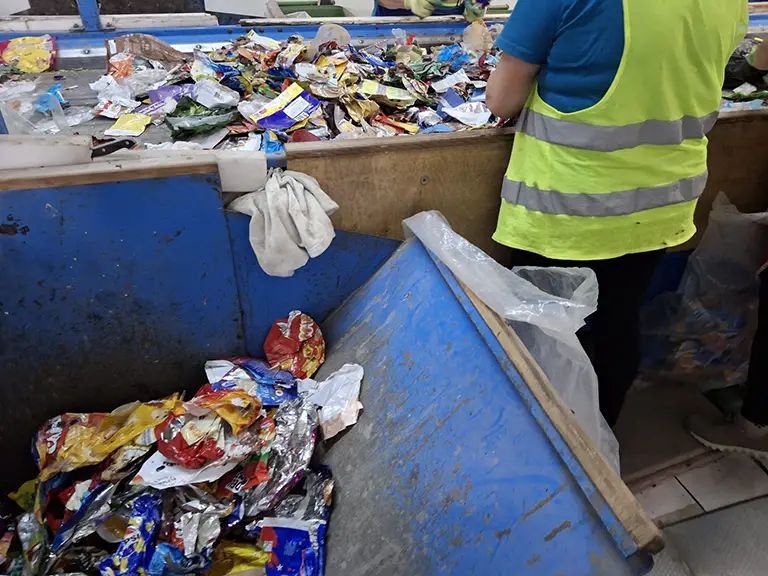
Testing was conducted on operational sorting lines using material as it arrived from collection – unprocessed, contaminated, mixed. This revealed what actually happens when flexibles move through real infrastructure. The fundamental observation: Recyclers managing appropriately sorted input encountered no fundamental technical obstacles. The issue lays earlier in the chain – principally with separate collection and then with manual sorting.
When finely sorted flexibles were run through one facility at the line’s natural speed, the manual workforce responsible for further separation simply could not sustain the required throughput. A single trained operator manages, on average, six tonnes per year; while an automated optical sorter processes equivalent volume in a much shorter time.
 At the parliamentary discussion on 23 June, the President of the Environmental Committee asked the RoFLEX team to specify precisely which legislative amendments – affecting collection standards, EPR modulation, sorting specifications and infrastructure investment – would be necessary to create functional material flows.
Member States are recognising the fundamental re-think of infrastructure design and operation needed to achieve legal targets for 2030 and 2035; solutions will require input from across the value chain.
The scale of the problem
Romania processes approximately 104,000 tonnes of municipal flexible plastic packaging annually – a quarter of Romania’s plastic packaging waste stream. For context: the country’s PET deposit return scheme (DRS) manages roughly 105,000 tonnes at 82 percent recovery. In tonnage terms, the flexible packaging challenge is essentially equivalent to the bottle collection system Romania has already successfully built. Yet flexible plastics currently receive no comparable infrastructure investment or policy attention.
This gap is not specific to Romania. Across much of central, eastern and southern Europe, flexible packaging remains outside the scope of dedicated collection and sorting infrastructure. The material is typically treated as residual waste rather than a targeted material stream. The EU Packaging and Packaging Waste Regulation now requires 55 percent recycling of flexible plastic formats by 2035; achieving this requires infrastructure, financing mechanisms, and measurement frameworks that many member states have not yet built.
From operational finding to policy recommendation
 Drawing on the data, the value chain collaboration set to work imagining a possible future. Five or six regionally distributed material recovery facilities equipped with modern optical sorting technology could serve Romania more efficiently than efforts to automate the existing 100-plus manual sorting locations simultaneously. Existing operations could continue handling pre-sorted material and lighter grading tasks. The group also suggested that the four polymer categories identified in testing could become national reference standards for collection and sorting.
Underpinning these operational recommendations is a structural shift in how Extended Producer Responsibility operates – one the collaboration identified for Romania too. In most EU Member States, national legislation disconnects legal and financial responsibility from operational control; immediate cost considerations disincentivise strategic, long-term intervention in infrastructure. Romania channels flexible packaging waste through 14 separate producer responsibility schemes (PROs) and over 100 different sorting centres, each operating according to its own collection and processing standards. This fragmentation makes it almost impossible to justify investment in automated sorting capacity or to guarantee stable feedstock to recyclers.
Extended Producer Responsibility – an essential strategic enabler
Pinpointing the vital role of EPR, discussions across CEFLEX and the RoFLEX pilot have also identified EPR reform at national level. Reflections from the CEFLEX management team – drawing on a range of European experiences – include: reforms requiring producers to hold both financial and organizational responsibility; defined roles and responsibilities for collectors, sorters, and recyclers; and PRO ownership of – or guaranteed access to – materials after collection. Furthermore, eco-modulated EPR fees according to recyclability and interim recycled content uptake before 2030 could create stable revenue streams for both collection infrastructure and mechanical sorting capacity, transforming what is now a cost burden into an investment opportunity.
Where flexible packaging recycling has improved across European systems – and where infrastructure investment has followed – the pattern is consistent: standardised collection underpinned by clear legal requirements; consolidated sorting centres equipped with modern optical technology; producer responsibility financing explicitly tied to material quality and recovery performance.
Translating evidence into policy
Equipped with RoFLEX evidence following the 23 June event, decision-makers are now engaging further to inform Romania’s national packaging waste management planning.
Simultaneously, CEFLEX’s broader work on circular economy implementation, EPR reform and sorting and recycling recommendations is feeding into policy discussions at EU level, where the forthcoming Circular Economy Act represents the opportunity for legislative guardrails that could enable member states to build the infrastructure this evidence supports.
Want to discuss circular economy implementation or insights from Romania directly? Don’t hesitate to reach out to the team:
Marius Tent, RoFLEX lead: marius@ceflex.eu
Fiona Durie, Advocacy Consultant: fiona.durie@ceflex.eu